Watermelon Drop
About Watermelon Drop
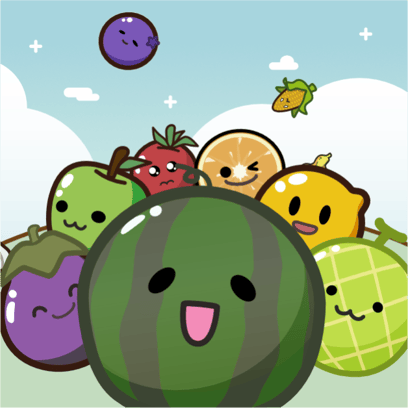
Watermelon Drop is an addictive physics-based puzzle game where players drop various fruits and vegetables into a container. When two identical items touch, they merge into a larger fruit. The ultimate goal is to create the biggest watermelon possible while strategically managing the limited space.
This game belongs to the popular "Suika Game" genre that went viral globally in 2023, offering simple mechanics with surprising depth and satisfying physics-based gameplay.
Key Features
Simple click-and-drop controls - easy to learn, challenging to master
Realistic physics engine making each playthrough unique
Progressive difficulty with strategic space management
Score ranking system from D to A ranks
No time pressure - play at your own pace
Cross-platform compatibility (desktop & mobile)
Target Audience
Watermelon Drop appeals to a wide range of players:
Casual Gamers: Looking for quick, relaxing gameplay sessions
Puzzle Enthusiasts: Enjoying strategic thinking and planning
All Ages: Simple mechanics suitable for children and adults alike
Mobile Players: Perfect for short breaks on smartphones and tablets
Competitive Players: Aiming for high scores and A-rank achievements
How to Play Watermelon Drop
The core gameplay revolves around dropping fruits into a cup-like container. Each fruit appears at the top of the screen, and you control when and where it drops. The challenge lies in the physics - fruits bounce, roll, and shift as they land, creating unpredictable outcomes.
When two identical fruits come into contact, they instantly merge into a larger fruit at the point of collision. This can trigger chain reactions when multiple fruits of the same type are positioned strategically.
Controls
The game uses intuitive mouse or touch controls:
Desktop: Move mouse to position fruit, click to drop
Mobile: Touch and drag to position, release to drop
Restart: Click 'Restart' button or press 'R' key
Editor's Review
Watermelon Drop captures that perfect balance of simplicity and addictiveness that makes casual games so compelling. The first few minutes feel deceptively easy - just drop fruits, watch them merge - but soon you're planning three moves ahead, anticipating physics reactions, and chasing that elusive A-rank score.
What really sets this game apart is the physics engine. Unlike predictable puzzle games, fruits bounce and roll in genuinely surprising ways. A well-placed cherry might roll across three other fruits to create an unexpected merge, or a pineapple might shift just enough to create space you didn't think existed. This randomness keeps each playthrough fresh, even after dozens of attempts.
The strategic depth reveals itself gradually. Early on, you're just trying not to overflow. Then you start thinking about chain reactions. Then you're calculating probabilities of certain fruits appearing. There's genuine satisfaction in executing a perfect sequence of merges that clears half the container and boosts your score dramatically.
For a free browser game, Watermelon Drop offers impressive production value. The visual design is clean and colorful, with each fruit clearly distinguishable. The sound effects provide satisfying feedback for merges without being distracting. And the complete lack of ads or paywalls makes it a genuinely accessible experience.
My only minor critique would be the lack of progressive unlocks or varied game modes. While the core gameplay is solid, some players might want additional challenges beyond just chasing higher scores. That said, the basic formula works so well that it's easy to see why this game went viral.
Frequently Asked Questions
What's the best strategy for creating a watermelon without overflowing the container?
Focus on creating stable foundations first. Start by merging smaller fruits at the bottom edges of the container to create a flat base. Keep medium-sized fruits separated until you have enough space to merge them without causing chain reactions that might overflow. Always leave a buffer zone at the top - if your fruits are approaching 75% full, prioritize merging what you have rather than waiting for perfect matches.
How does the scoring system work and what determines your final rank?
The score increases with each merge, with larger fruits providing exponentially higher points. Creating a watermelon typically gives the biggest score boost. Your final rank (D through A) is determined by your total score relative to statistical benchmarks. To achieve A-rank, you generally need to create multiple watermelons while maintaining efficient space usage throughout the game.
Are there any hidden mechanics or special moves that advanced players should know about?
Yes, experienced players utilize "cluster rush" effects - positioning fruits so that multiple merges happen simultaneously, creating larger fruits in a single chain reaction. Also, understanding fruit weight and bounce patterns is crucial. Heavier fruits like pineapples and melons tend to shift lighter fruits when they land, which can be used strategically to create merges you couldn't achieve through direct placement.
What happens when you create multiple watermelons in a single game?
Each watermelon created significantly boosts your score and clears substantial space in the container. Experienced players often aim for multiple watermelons as this is the most reliable path to high scores and A-rank achievements. However, be cautious - the process of working toward additional watermelons requires careful space management and strategic fruit placement throughout the entire game.
How does the game's physics engine affect strategy compared to similar merge puzzle games?
The physics adds an element of unpredictability that forces adaptive playstyles. Unlike games with perfectly predictable outcomes, you must account for fruits rolling, bouncing, and shifting after impact. This makes certain strategies like "edge stacking" (letting fruits settle against container walls) more effective, while others like "center accumulation" become riskier due to potential instability.